Inside the Data Engineer’s Toolkit: Python, Spark, Airflow and Cloud Workflows
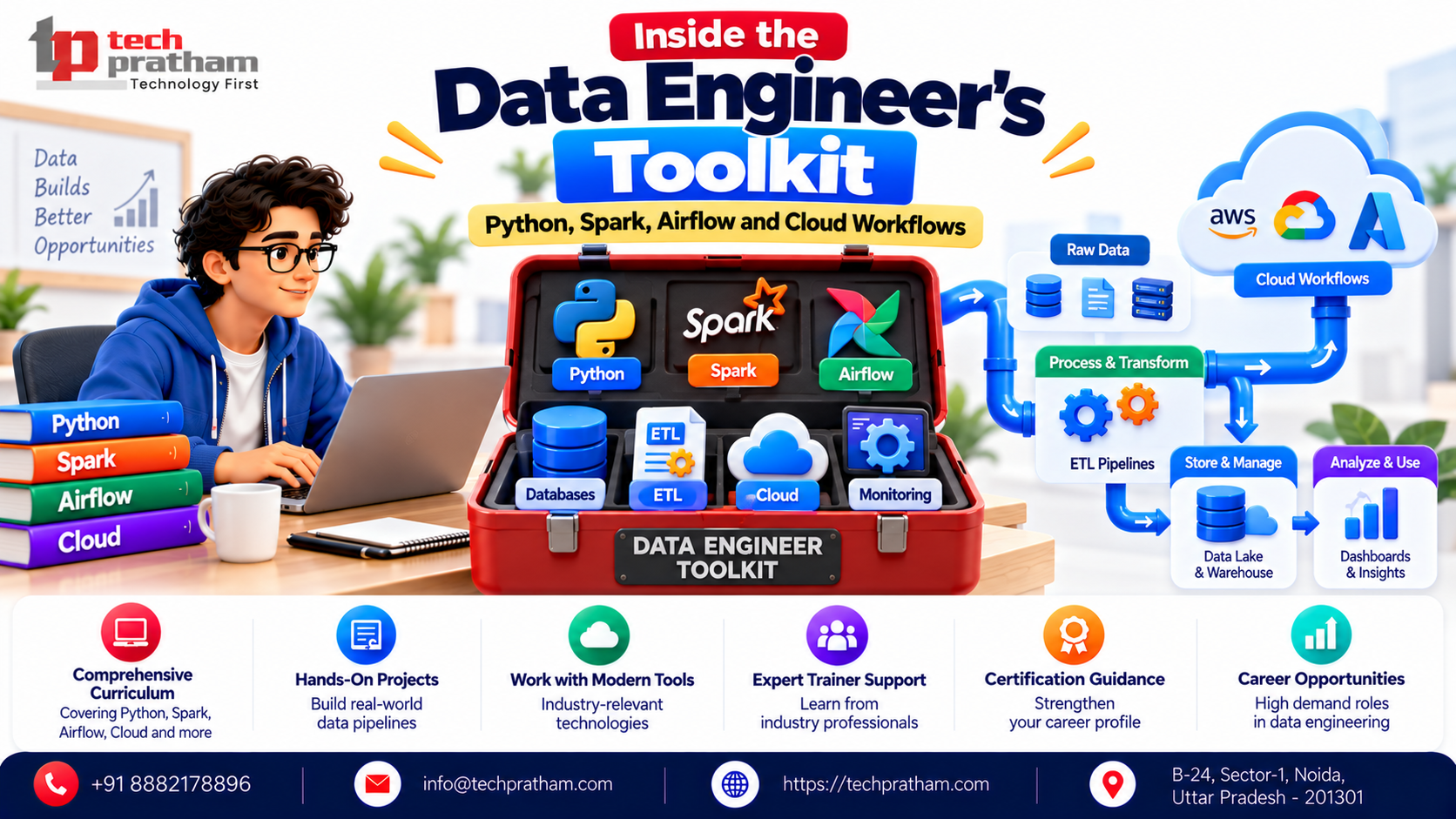
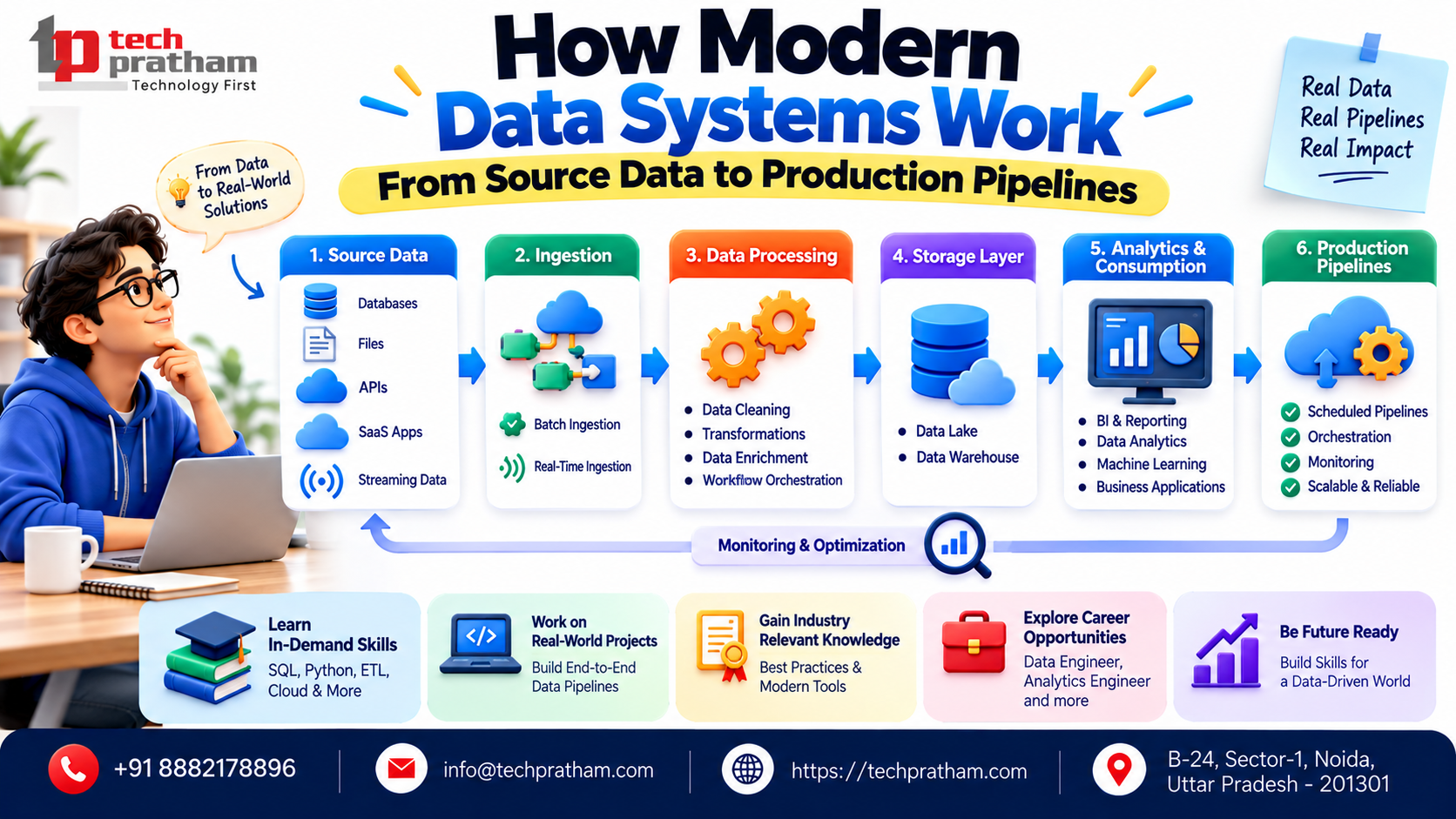
A modern data platform is rarely built using a single technology. It may combine Python scripts, SQL queries, cloud storage, databases, transformation frameworks, distributed processing, and workflow orchestration. Each component performs a specific task, but the real engineering challenge lies in making the components work together reliably. A pipeline must retrieve the correct records, transform them consistently, load the output safely, and provide enough monitoring to detect failures.
Developers who understand this end-to-end process can build more maintainable data systems than those who focus only on individual tools. For aspiring data engineers, learning the purpose of each component and understanding how it fits into a broader architecture is a practical way to develop technical confidence.
How Data Engineering Certification Training in India Connects the Modern Data Stack
It can help learners understand how common technologies fit into a complete data workflow. Instead of treating Python, SQL, cloud services, and orchestration as separate subjects, a structured curriculum can connect them through practical implementations.
Imagine a company that collects transaction data from an application and customer information from a separate database. Data Engineering Certification Training in India pipeline needs to retrieve both datasets, standardize their fields, combine related records, and store the result for analysis.
Python may handle extraction and custom processing. SQL may validate and transform structured records. Cloud storage may hold raw data, while a warehouse stores prepared analytical tables. An orchestration tool can schedule the tasks and manage dependencies. Understanding this architecture is more valuable than simply memorizing tool names.
Python: The Automation Layer
Python is useful for integrating systems, processing files, calling APIs, and automating repetitive data tasks. A well-organized Python pipeline should separate its responsibilities into reusable functions. For example, one function might retrieve data, another might validate the response, and a third might load the processed records into a destination.
Exception handling is also essential. Network requests can fail, files may be missing, and source data may contain unexpected fields. Logging these events helps engineers investigate issues rather than allowing failures to go unnoticed. Learners should practise working with CSV and JSON formats, API responses, database connections, and reusable code modules.
SQL: Querying and Transforming Structured Data
SQL is central to many data engineering workflows because structured records are frequently stored in relational databases and warehouses. Core skills include joins, aggregations, subqueries, common table expressions, and window functions. Engineers use these techniques to combine datasets, remove duplicates, calculate metrics, and validate business rules.
For instance, a pipeline may need to compare the number of records extracted from a source with the number successfully loaded into a destination. SQL can help perform this reconciliation. Query optimization becomes important as datasets grow. Learners should understand how query structure, indexing, partitioning, and data models can affect performance.
Apache Spark: Processing Larger Datasets
Apache Spark supports distributed data processing. It can be useful when data volumes or computational requirements exceed what a simple local script can handle efficiently. Learners should first understand the difference between local and distributed processing. Concepts such as DataFrames, transformations, actions, partitions, and execution plans help explain how Spark processes data.
Spark should not be added to every project automatically. For a small dataset, a straightforward Python script or SQL query may be sufficient. The choice should depend on scale, performance, and operational requirements.
Apache Airflow: Coordinating Pipeline Tasks
A data workflow may contain multiple dependent tasks. A transformation should not begin until the required data has been retrieved, and a reporting table should not be refreshed until the transformation succeeds.
Apache Airflow can help coordinate such workflows using directed acyclic graphs, commonly called DAGs. Tasks define the work, dependencies determine the execution order, and scheduling controls when workflows run. Learners should explore retries, task failures, logging, scheduling, and monitoring. These concepts help turn individual scripts into an organized workflow.
Cloud Platforms and Data Storage
Cloud platforms provide managed storage, databases, processing services, and analytical infrastructure. They can support scalable data systems while introducing responsibilities related to security, access permissions, resource usage, and cost management.
A good learning path covers the underlying principles before moving deeply into a particular cloud provider. Learners should understand how data is stored, how processing resources are selected, and how permissions affect pipeline execution. Data warehouses and data lakes serve different purposes, so it is important to understand their use cases rather than treating them as interchangeable technologies.
Choosing a Data Engineering Course in India
When comparing a Data Engineering Course in India, check whether the curriculum connects the major technologies through end-to-end exercises. A strong program should cover Python, SQL, data modeling, ETL/ELT, data warehousing, cloud fundamentals, orchestration, and monitoring. Practical assignments should require learners to build and troubleshoot workflows.
Data Engineering Training in India can be especially valuable when the teaching approach includes code reviews, guided exercises, and realistic project scenarios.
Certification and Project-Based Learning
Data Engineering Training Online in India can provide flexibility for learners who need to study around work or college. A Data Engineering Course Online in India should still include practical exercises and a clear learning sequence.
Certification can provide structure, but learners should also build projects demonstrating how the technologies work together. One useful project is a pipeline that retrieves API data, validates it using Python, loads it into a database, creates SQL summary tables, and runs through a scheduled workflow. Document the architecture, error handling, and validation results. These details demonstrate a deeper understanding of the engineering process.
Conclusion
Python, SQL, Spark, Airflow, and cloud platforms address different parts of modern data engineering. The challenge is to understand when each technology is useful and how to connect the components into a dependable system.
For a structured curriculum, review Data Engineering Training. Compare the syllabus, practical assignments, and project coverage with the technical skills you want to develop.
Comments
Join the discussionNo comments yet. Be the first to comment.