How Modern Data Systems Work: From Source Data to Production Pipelines
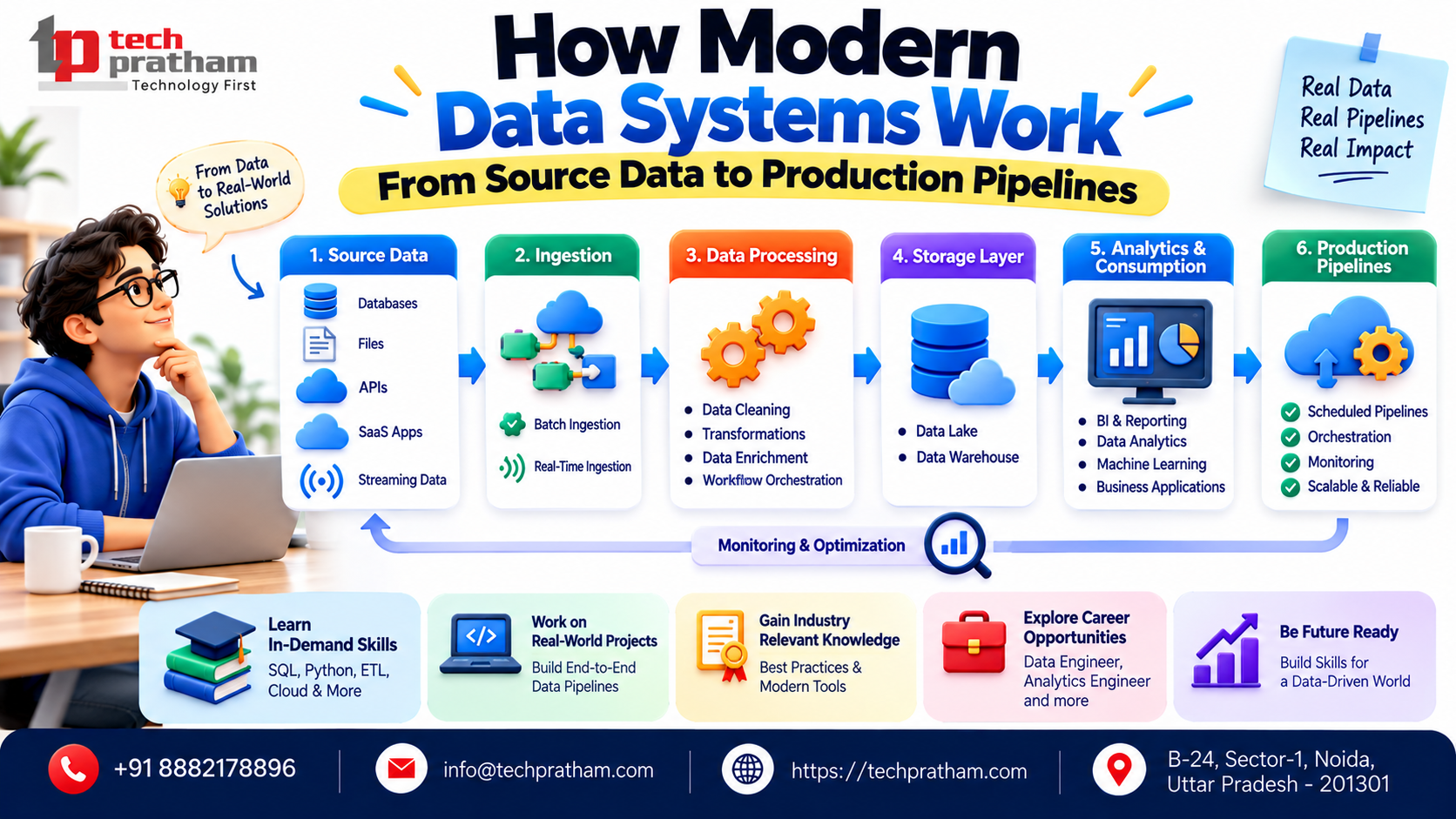
A modern application does not operate on code alone. Behind its interface, many systems generate events, store transactions, update customer records, and send information to other services. Engineering teams need a dependable way to move this data into analytical platforms without losing important details or creating inconsistent results. This is the purpose of a data pipeline.
A pipeline can be a straightforward script that imports a file into a database, or it can be a complex workflow involving APIs, distributed processing, cloud storage, validation, and scheduling. Understanding the complete journey from source data to a production-ready dataset is one of the most useful ways to begin learning data engineering. It also provides a practical foundation for exploring the tools used by data teams.
Building a Foundation with a Data Engineering Course in India
It can help learners understand how individual technologies fit into a complete data architecture. Rather than treating Python, SQL, cloud storage, and orchestration as unrelated subjects, structured learning connects them through real workflows. Consider an application that records customer purchases. The application may store transactions in a database, while customer-support information sits in another system and product details are maintained separately. An analytics team needs a consistent view of all three sources.
In Data Engineering Course in India data pipeline can extract the relevant records, normalize their formats, validate key fields, combine related datasets, and load the results into an analytical destination. The pipeline must also handle failures and ensure that repeated runs do not introduce duplicate records. This is the difference between writing a script that works once and engineering a workflow that can operate repeatedly.
Step 1: Understand Your Data Sources
Data pipelines begin with sources. These may include relational databases, CSV and JSON files, application APIs, event streams, logs, and cloud-based applications.
Each source has its own structure and behavior. A CSV file may contain a fixed set of columns, while an API may return nested JSON objects. A database may be updated continuously, requiring the pipeline to retrieve only new or changed records.
Before writing code, identify:
Where the information originates.
How frequently the source changes.
Which fields are required.
How records can be uniquely identified.
What authentication or access permissions are needed.
How source failures should be handled.
This preliminary analysis prevents avoidable problems later in the workflow.
Step 2: Use Python to Extract and Process Data
Python is useful for reading files, calling APIs, automating repetitive tasks, and applying transformation logic. A practical learning exercise might involve reading a collection of sales files, checking whether required columns exist, converting dates into a consistent format, and rejecting records that do not meet basic validation rules.
Reliable code should account for unexpected inputs. Files may be empty, fields may be missing, and network requests may fail. Exception handling and logging help make these situations easier to investigate. As projects become more complex, code should be divided into reusable functions and modules. This makes testing easier and reduces the risk of maintaining a large script that performs every task in one place.
Step 3: Use SQL to Transform and Validate Data
SQL remains an essential skill because many data workflows interact with relational databases and analytical warehouses. Learners should practise joins, aggregations, common table expressions, window functions, filtering, and query optimization. These techniques support tasks such as identifying duplicate transactions, calculating daily totals, matching customer records, and creating reporting tables.
Validation is equally important. A pipeline should not simply move records from one location to another. It should check whether required fields are present, whether values fall within expected ranges, and whether relationships between tables remain valid. For example, an order referencing a customer ID that does not exist in the customer table may indicate a source issue or a transformation problem. Detecting that inconsistency early improves downstream reliability.
Step 4: Design an ETL or ELT Workflow
ETL and ELT describe common approaches to moving and transforming information. In ETL, data is extracted, transformed, and then loaded into its destination. In ELT, data is extracted and loaded first, with transformation occurring in the destination environment. The right approach depends on the source systems, processing requirements, platform capabilities, and governance needs.
A production-oriented pipeline may include several stages:
Extract records from a source.
Store a raw copy when appropriate.
Validate structure and required fields.
Apply transformations.
Load the results into a target system.
Record processing metrics.
Report failures and support safe retries.
Idempotency is an important design consideration. Ideally, rerunning a failed task should not create duplicate business records or corrupt the destination.
Step 5: Explore Cloud Storage and Distributed Processing
When datasets become too large for simple local processing, engineers may use cloud storage, managed data warehouses, and distributed processing frameworks. Apache Spark supports processing large datasets across distributed computing resources. Data lakes provide a way to store different types of information, while data warehouses are commonly used for structured analytical workloads.
The goal is not to use every available technology. Instead, engineers should understand the problem each tool solves and select a suitable architecture based on volume, latency, cost, security, and maintenance requirements. Cloud platforms also introduce responsibilities involving permissions, access controls, monitoring, and resource management.
Step 6: Automate and Monitor the Pipeline
A pipeline that depends on someone manually running a script is difficult to operate at scale. Workflow orchestration tools can schedule jobs, manage dependencies, retry failed tasks, and show execution status.
Monitoring should cover more than whether a task completed. Useful signals include the number of records processed, processing duration, failed records, data freshness, and unexpected changes in data volume. A pipeline may finish successfully while still producing incorrect results. For this reason, data quality checks should be part of the workflow rather than an afterthought.
Building These Skills Through Structured Training
Learners comparing Data Engineering Training in India should look for a curriculum that connects programming, SQL, data modeling, pipeline design, cloud services, and monitoring. A strong Data Engineering Certification Training in India program can offer structure through assignments, assessments, and projects. Still, learners should verify that the certification process includes meaningful practical work rather than only watching lessons.
For people who need flexibility, Data Engineering Training Online in India and a Data Engineering Course Online in India may provide a convenient route to practising these skills around work or college commitments. The important factor is consistent implementation. Build small pipelines first, test them thoroughly, and then add scheduling, monitoring, and more complex processing.
A Project to Bring Everything Together
Try creating a pipeline that ingests public data from an API, stores the original response, transforms selected fields using Python, and loads cleaned records into a database. Use SQL to generate summary tables, then add validation checks for missing values and duplicate identifiers.
Document the architecture, assumptions, failure scenarios, and steps needed to run the project. If possible, schedule the pipeline and add logging so another person can understand what happened during an execution.
Conclusion
Modern data engineering is the practice of building reliable systems around data movement, transformation, storage, and delivery. Learning the tools individually is useful, but understanding their relationships is what makes a project complete.
Begin with SQL and Python, develop ETL or ELT workflows, and gradually explore cloud infrastructure, distributed processing, and orchestration. For a structured learning option, review the Data Engineering Training Online in India and assess whether its topics and project work align with your goals.