Inside a Selenium Automation Stack: WebDriver, Elements, Waits, and Test Design

A browser automation framework is more than a collection of commands. Reliable automation depends on several layers working together: browser control, element identification, synchronization, test logic, programming, and execution.
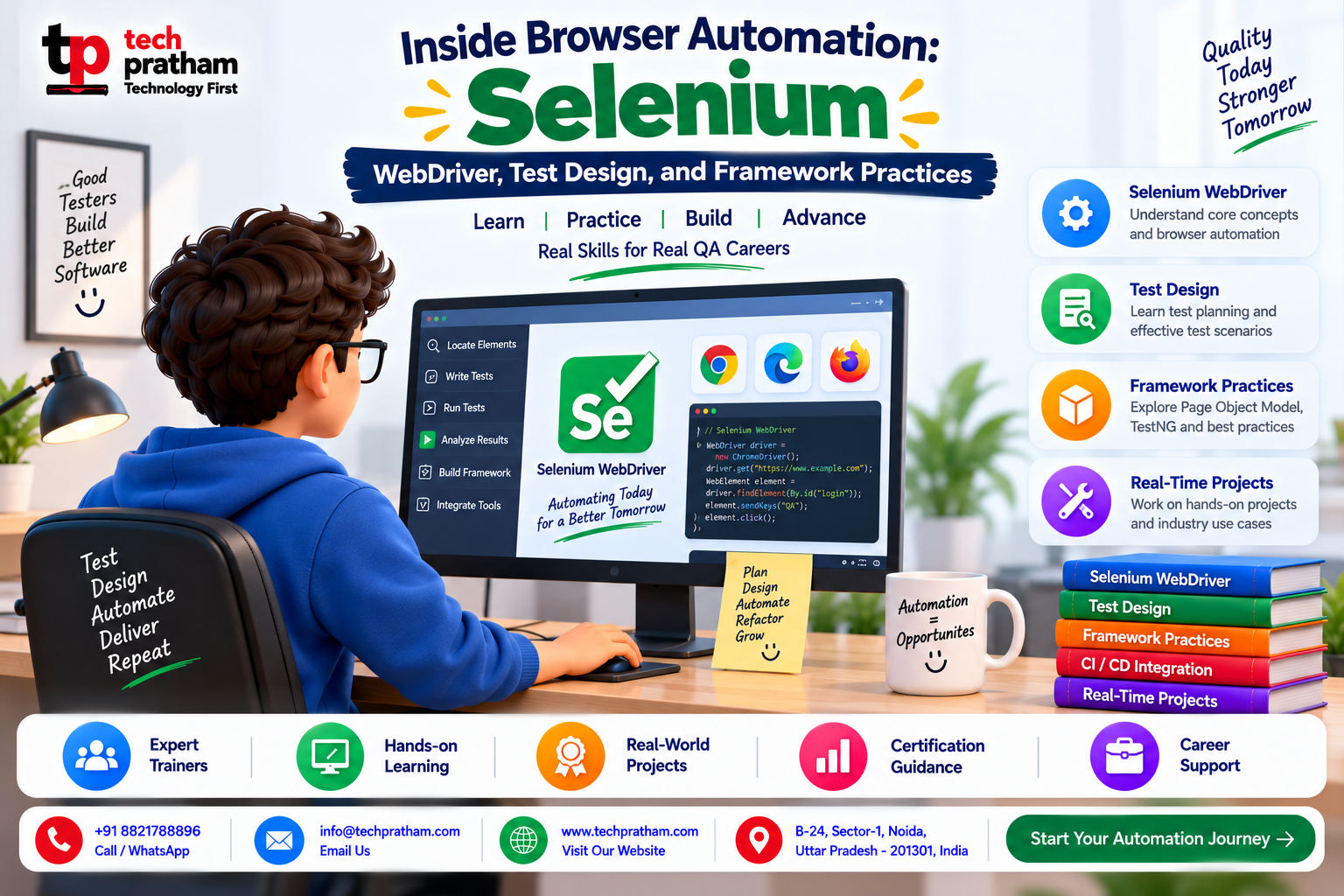
Selenium provides a collection of tools and libraries for browser automation, with WebDriver at the center of its browser-control capabilities.
For engineers and QA professionals looking to understand these components systematically, Selenium Automation Testing Training can provide a practical route from basic WebDriver usage to organized automation architecture.
WebDriver Layer
WebDriver provides a language-neutral interface for controlling browsers. It can operate browsers locally or through a remote Selenium server.
A basic automation flow includes creating a driver session, navigating to a URL, finding elements, performing actions, validating results, and closing the session. Understanding this flow is the starting point for Selenium development.
Element Layer
Automation interacts with web elements rather than abstract screens. A test may need to locate a username field, password field, button, navigation link, table, or confirmation message. Reliable element identification is therefore essential.
Learners should understand locator strategies and consider the stability of selectors when application interfaces change.
Synchronization Layer
Modern applications frequently load content asynchronously. This creates a common automation problem: the script may attempt to interact with an element before the application has made it available.
Selenium identifies synchronization as a major challenge and provides implicit and explicit waiting mechanisms. Explicit waits can be used to wait for specific conditions, such as visibility or availability of an element. Understanding this layer is essential for reducing flaky tests.
Test Design Layer
A browser action does not automatically constitute a test. Test design defines what should happen and how the result should be verified.
For example, a payment workflow could contain multiple checkpoints: successful navigation, correct product information, valid form submission, and confirmation. Assertions make these expectations explicit.
Programming Layer
Programming provides the structure needed for reusable automation. Variables, conditions, loops, methods, classes, collections, and exception handling help testers create maintainable scripts.
This is why a technical Selenium Testing Training program should include coding rather than treating Selenium as a collection of isolated commands.
Framework Layer
Large projects need structure. Page components, test classes, utilities, configuration, test data, and reporting can be separated into logical modules.
A framework should make automation easier to maintain rather than simply adding complexity. Test runners can also support organized execution as the number of tests increases. Selenium's getting-started documentation includes guidance on organizing and executing Selenium code.
Execution Layer
The final layer involves where and how tests are executed. Cross-browser testing may require multiple browser environments. Selenium Grid can distribute WebDriver tests across machines and support parallel execution.
This introduces important concepts such as remote execution, browser capabilities, nodes, and environment management.
Building the Stack Through Projects
Rather than learning each layer separately, learners can combine them through a project.
An e-commerce automation framework, for example, could include login, product search, cart validation, checkout, and logout. Each scenario can use page components, reusable utilities, synchronization, assertions, and structured test execution. This project-oriented approach is useful when evaluating a selenium testing course.
Online Learning Considerations
A Selenium Testing program can help learners study these layers remotely while maintaining access to practical exercises.
When researching selenium testing training in India, consider whether the curriculum includes WebDriver, programming, locators, synchronization, frameworks, and projects.
Those comparing a selenium testing course in India should also examine how much hands-on work is included. A Selenium Testing Course online in India can be useful for learners who want flexibility while developing practical automation skills.
Conclusion
A strong Selenium automation stack combines WebDriver, reliable element handling, synchronization, test design, programming, framework architecture, and execution infrastructure.
Understanding how these layers connect is more valuable than memorizing individual commands. With structured Selenium Testing Training online in India and project-based practice, learners can gradually develop the skills needed to create reliable and maintainable web automation suites.