From WebDriver Basics to Test Frameworks: A Practical Selenium Learning Journey
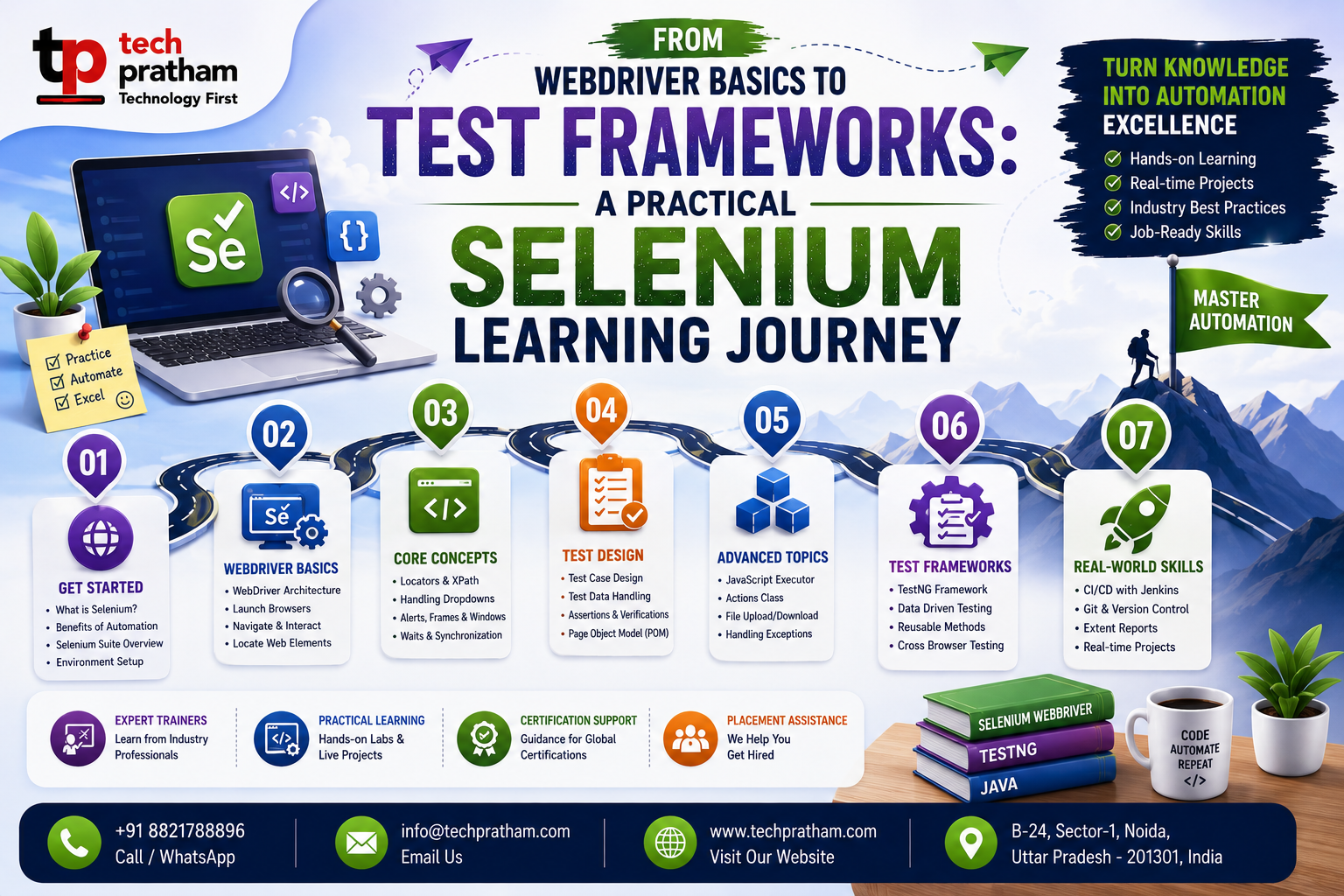
Learning Selenium often begins with a simple browser automation script. Opening a browser, navigating to a webpage, entering text, and clicking a button can provide an immediate introduction to how automation works.
However, professional test automation involves more than basic browser commands. Real applications contain dynamic elements, changing page structures, asynchronous requests, multiple test environments, and complex user workflows.
To create reliable automation, testers need to understand testing principles, programming, synchronization, framework design, and maintainable coding practices.
A structured Selenium Testing Course in India can help learners progress from WebDriver basics toward practical framework development and real-world automation projects.
Understand WebDriver First
WebDriver allows automation scripts to communicate with supported browsers. A typical test can navigate to an application, locate elements, perform actions, and verify results. Understanding this workflow is the first step toward browser automation.
Learn How to Locate Elements
Web applications contain many elements that automation scripts need to identify. Common strategies include IDs, names, XPath, CSS selectors, and class names. Choosing stable locators can reduce maintenance problems when applications change.
Handle Dynamic Applications
Modern applications frequently load content asynchronously. Automation scripts need to wait for elements to become available before interacting with them.
Understanding synchronization and wait strategies is therefore essential for building reliable tests. Learners exploring selenium testing should spend sufficient time practicing these real-world scenarios.
Add Programming Knowledge
Automation depends on programming logic. Variables, loops, conditions, methods, collections, and exception handling allow testers to create flexible and reusable scripts. Programming skills become increasingly important as projects grow.
Introduce Assertions
Automation scripts should validate outcomes instead of simply performing actions. Assertions allow testers to compare expected and actual behavior.
For example, after submitting a login form, a test can verify that the user reaches the correct dashboard.
Build Maintainable Frameworks
Individual scripts can become difficult to manage in larger projects. Frameworks help organize automation. TestNG and JUnit can support execution and reporting, while Page Object Model can separate webpage actions from test logic.
A practical selenium testing course should introduce these concepts because maintainability is an important part of professional automation.
Work on Complete Projects
Projects provide opportunities to combine multiple concepts.
An e-commerce automation project can include registration, login, product search, filtering, cart operations, and checkout.
Advanced projects can add data-driven testing, reports, screenshots, and reusable components.
Expand Beyond Selenium
Selenium works well as part of a broader QA skill set. SQL can support database validation, API testing can help test backend services, and Git can support version control.
CI/CD knowledge can also help testers understand automated testing pipelines. A comprehensive selenium testing training approach should encourage learners to explore these complementary technologies.
Build Career-Ready Skills
Automation knowledge can support roles such as Automation Tester, QA Engineer, Test Automation Engineer, and SDET.
A project-focused selenium automation testing training program can help learners develop practical experience and improve their ability to solve real automation problems.
Conclusion
A successful Selenium Testing Training in India learning journey moves beyond basic WebDriver commands. Reliable automation requires good locators, synchronization, programming, assertions, frameworks, and maintainable project structures.
By learning these concepts step by step and applying them through projects, aspiring testers can build stronger technical automation skills.